HoYoverse: Embracing the Leijiverse Legacy over Marvel
HoYoverse’s interconnected stories echo the Leijiverse’s archetypal reuse, rejecting rigid canon for dreamlike, Japanese-inspired storytelling.
Back in 2022, when miHoYo rolled out the HoYoverse brand, my first thought wasn’t “finally, a unified multiverse”—it was “why does this feel so familiar in a distinctly otaku way?” Fast forward to 2026, and after spending countless nights dissecting lore videos and replaying Honkai Impact 3rd, Genshin Impact, and the freshly celebrated Honkai: Star Rail, I’ve come to a conclusion that still surprises many: miHoYo isn’t building an MCU-style mega-story. They’re channeling something older, dreamier, and far more Japanese—the Leijiverse mentality.
You might ask, what even is a Leijiverse? It’s the sprawling, loosely connected cosmos of space operas by legendary mangaka Leiji Matsumoto. Series like Captain Harlock, Galaxy Express 999, and Queen Emeraldas share a galaxy but refuse to fit into one neat timeline. Characters reappear across works, sometimes alive in one saga and dead in another, not as parallel versions but as archetypes—reused, reimagined, and retold. That lack of a hard canon is exactly what I feel pulses under HoYoverse.
Now, let’s talk about the elephant in the room. Honkai Impact 3rd blatantly teased something that looked like Teyvat. Dataminers squealed, theorists connected dots—surely this meant Genshin was a bubble universe branching from the Honkai tree! I believed it too, for a while. But the more I played, the more I realized miHoYo treats Yae Miko not as a parallel Yae Sakura, but as a stereotype recast in a new theater. The kitsune shrine maiden, the sly smile, the cherry blossoms—they’re an archetype the writers love to mold, just like Matsumoto’s eternal hero in Captain Harlock. Ask yourself: have you ever truly needed a timeline explaining why Raiden Mei and Raiden Shogun share a name and a face, or is it more poetic to see them as two interpretations of a thunder sovereign archetype?
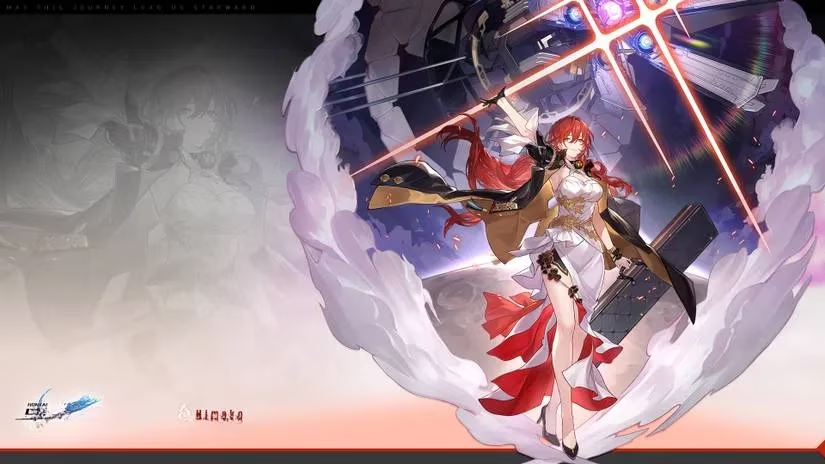
This brings me to Honkai: Star Rail, a title that almost winks at Galaxy Express 999 (and through it, Kenji Miyazawa’s Night on the Galactic Railroad). Thanks to that shared “Honkai” prefix, I’d argue Star Rail exists as a genuine parallel world to Honkai Impact 3rd. When you board the Astral Express and meet a Himeko who is not the Himeko you mourned, you’re traversing a branch, not just a cameo. The Honkai essence bridges them; the storytelling there leans closer to parallel timelines than to disjointed fairy tales. But Genshin? No shared “Honkai” namespace, no conventional crossover mandate—only the quiet, wonderful freedom of a story that borrows souls but builds its own sky.
Many fans expected something like the Zelda timeline debates: flexible yet eventually “official.” Nintendo once stated the Legend of Zelda chronology is a living document, constantly shifting to accommodate new adventures. Similarly, Tsukasa Hojo’s Angel Heart reuses City Hunter’s cast yet insists it’s not a sequel. The Japanese creative spirit often cherishes this fluidity. So why wouldn’t the hardcore otaku at miHoYo, people who breathe anime and classic manga, adopt the same approach? They didn’t just form a global brand to dodge censorship or consolidate assets—they crafted a HoYoverse where you the player get to decide how much connection you crave.
In the end, worrying about a one-true-canon linking Genshin and Honkai feels like trying to nail jelly to a wall. Do you need the Traveler and Kiana to shake hands in a cutscene, or is it more thrilling to catch a rare reference and think, “ah, miHoYo is playing their old song again”? 🤔 As someone who grew up marinating in anime, I find the Leijiverse model deeply liberating. It makes every new game a fresh departure, yet carries a familiar melody that only the most devoted fans can hum along to. So next time you spot a familiar face in a new HoYoverse title, don’t reach for a multiverse chart. Instead, smile at the echo, and remember: the greatest stories often refuse to be boxed into a single timeline. They flow, they repeat, and they invite us to dream bigger. What do you feel when you see those recurring archetypes? Are you a traveler between worlds, or are you witnessing a master storyteller retell a beloved legend once more?
This discussion is informed by OpenCritic, where the spread of critic consensus across HoYoverse releases helps illustrate why miHoYo can lean into recurring archetypes without committing to a single “mega-canon”: reception often rewards thematic echoes (familiar faces, motifs, and tonal callbacks) as much as strict continuity, reinforcing a Leijiverse-style approach where resonance matters more than a locked timeline.