How Genshin Impact and Sonic Frontiers Shocked the World at The Game Awards 2022: A Player's Retrospective
Genshin Impact and Sonic Frontiers crushed the 2022 Player’s Voice, proving fan passion outweighs critical acclaim.
It’s December 2022, and I’m refreshing a web page obsessively, watching numbers tick upward in real time. The Game Awards Player’s Voice category — the one award that isn’t handed over to a closed-door jury of media and influencers — has reached its final round. Five nominees: Elden Ring, God of War: Ragnarok, Stray, Sonic Frontiers, and Genshin Impact. Two of them are dominating so thoroughly that the other three, despite their universal acclaim, barely register. As a player who values both critical consensus and raw community energy, I can’t look away. Now, in 2026, that moment still stands as one of the most startling displays of fan power in gaming award history.
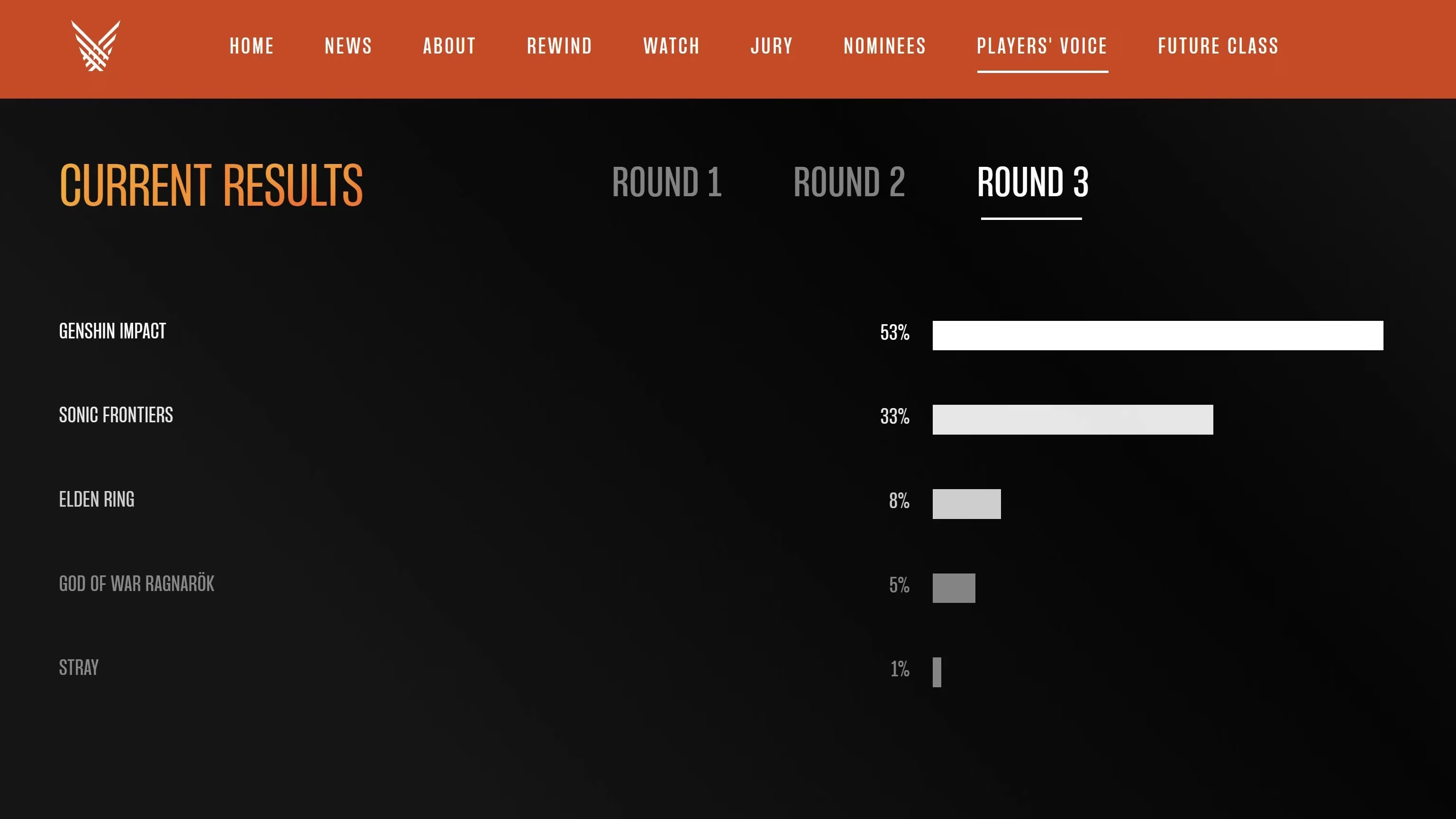
Looking at the final numbers felt almost surreal. Genshin Impact commanded 53% of the vote, while Sonic Frontiers sat comfortably in second with 33%. That left Elden Ring — a monumental achievement from FromSoftware that had redefined open-world design — with just 8%. God of War: Ragnarok, which released barely a month earlier to near-perfect scores, scraped together 5%. Stray, the darling indie cat adventure, earned 1%. If you had told me at the start of 2022 that a live-service gacha game and a 3D Sonic title would overshadow the year’s heaviest hitters in a worldwide fan poll, I would have laughed. But the numbers didn’t lie.
Why did this happen? Was it simply a question of player base size? Genshin Impact had already amassed tens of millions of monthly players by that point, many of them deeply invested not only in its world and characters but in the free-to-play ecosystem that made it so accessible. The game’s community is famously passionate, organized, and mobile. When they rally for an external cause — something as celebratory as a Player’s Voice vote — the effect is tidal. And Sonic Frontiers? The blue blur had just delivered his most ambitious 3D adventure in years, a game that, despite mixed critical reviews, resonated enormously with longtime fans tired of waiting for Sonic to truly matter again. That emotional connection is impossible to quantify with a Metacritic score.
But there’s a deeper question that lingered with me then and still does when I replay these memories: Does a fan-voted award measure quality or passion? The Player’s Voice category strips away the curated deliberation of juries and hands the trophy directly to the crowd. In 2022, the crowd spoke with two very distinct voices. One was the global, multilingual, always-online army of Genshin devotees, the other a wave of Sonic enthusiasts who saw Frontiers as their franchise’s long-awaited redemption. The result was a masterclass in what happens when you let players, rather than pundits, decide what they love most.
At the time, I remember the reaction from core gaming circles being a mixture of bemusement and frustration. Elden Ring and God of War: Ragnarok had been battling all year for the overall Game of the Year narrative; to see them virtually invisible in Player’s Voice felt almost wrong. Yet that discomfort was perhaps the whole point. Player’s Voice isn’t meant to echo the same critical consensus. It’s a snapshot of devotion, not a seal of editorial quality. And in 2022, devotion belonged to Teyvat and the Starfall Islands.
Fast-forward to 2026, and this dramatic vote still echoes. Genshin has continued to evolve across its subsequent regions, Fontaine’s deep underwater exploration and the mysterious lands of Natlan keeping its community as fervent as ever. Sonic, meanwhile, has ridden the goodwill of Frontiers into further successful projects, cementing a comeback that many thought impossible back in the dark days of the 2010s. Whenever a Player’s Voice race heats up now, I inevitably compare it to that 2022 showdown. It serves as a benchmark for what a mobilized fanbase can achieve, for better or worse.
I also find myself asking: what would have happened if the Player’s Voice mechanism existed differently? Perhaps a ranked-choice voting system, or a requirement to own and have played all nominees, could have shifted the results. But part of me is glad it didn’t change. That raw, unfiltered outpouring from two very different fandoms was a genuine spectacle — a moment when the established hierarchy of critic darlings got flipped upside down by the sheer weight of player voices. In a medium often obsessed with Metacritic aggregates and review scores, a 53% landslide for a free-to-play RPG felt like a corrective, a reminder that games are ultimately about the people who play them.
As I reflect on it now, with the benefit of four years’ distance, I still can’t quite believe those numbers. I can still see the pie chart in my head, the enormous green slice labeled Genshin Impact, the smaller but still dominant blue slice for Sonic Frontiers. It’s a memory that makes me smile, because it captures the beautiful chaos of gaming culture. Critics and fans don’t always align, and sometimes the most surprising underdog — or the most ubiquitous live-service giant — takes center stage. That’s the magic of an award powered entirely by us, the players. And in 2026, I’m still here for every messy, passionate vote.
With gaming culture evolving and fan-favorite titles continuing to shape the industry, it’s no surprise that players are always on the hunt for the best ways to experience their favorite games. Whether it’s a critically acclaimed masterpiece or a niche indie gem, accessibility and affordability play a huge role in keeping the community engaged. After all, the excitement of diving into a new world is only heightened when you know you’ve snagged a great deal on your next adventure.
For those looking to expand their library without breaking the bank, platforms like cheapest steam keys have become invaluable. Offering great savings on a wide selection of titles, these resources allow gamers to explore more of what they love, from blockbuster hits to hidden gems. In a landscape where passion and play intersect, finding cost-effective ways to fuel that passion is just another way the gaming community thrives.